August 16, 2026
Investment Opportunities in Iraq for Swiss Companies in 2026
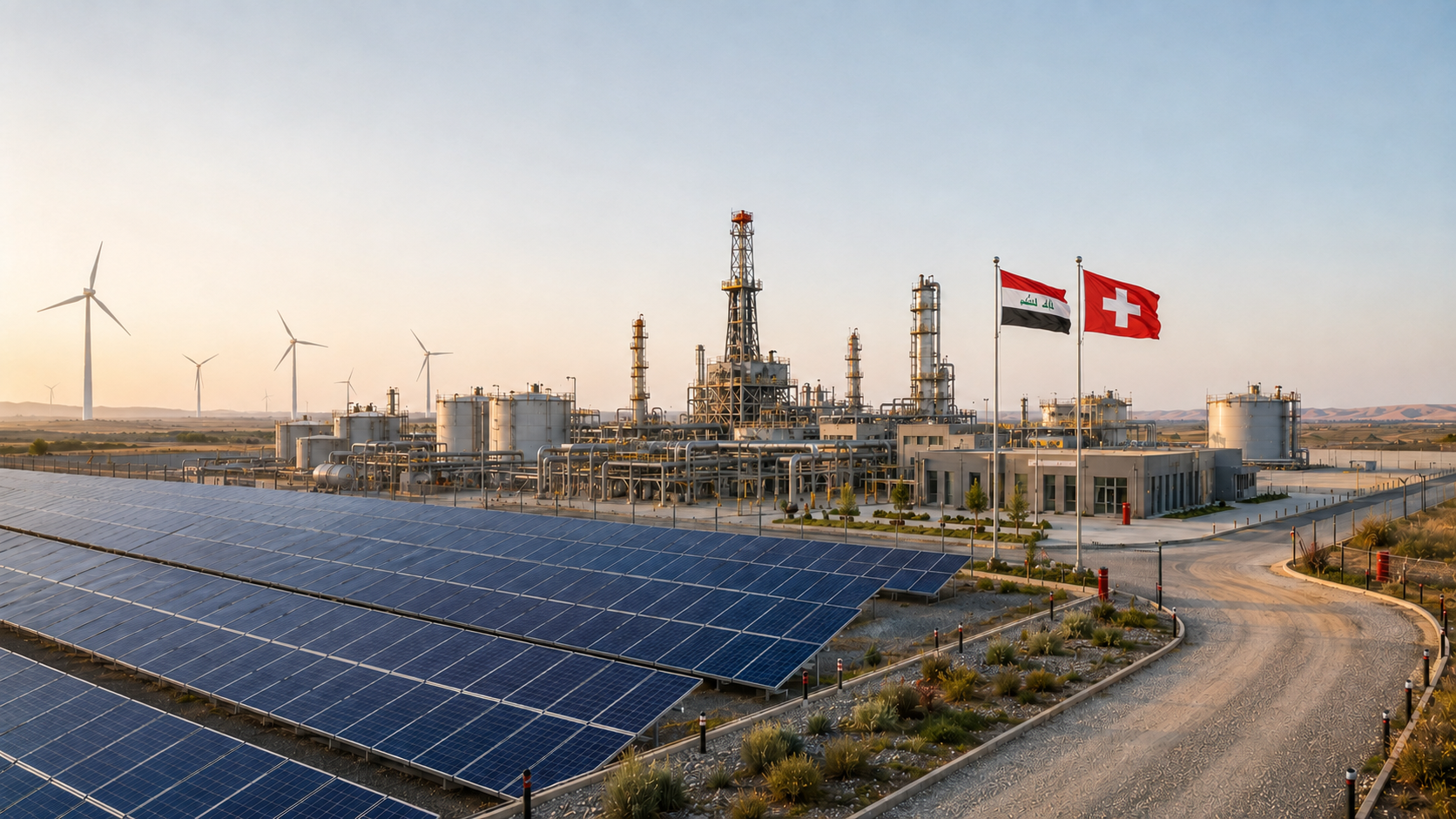
Iraq is entering a period in which infrastructure development, economic diversification, energy needs, digital transformation, and private-sector growth are creating new investment opportunities in Iraq for international companies. For Swiss businesses, particularly those with expertise in engineering, pharmaceuticals, environmental technologies, energy, infrastructure, manufacturing, and specialized services, the Iraqi market presents areas worth evaluating carefully in 2026.
The opportunity, however, is not simply about entering a large market. Successful investment requires understanding where demand exists, how individual sectors are developing, which local partnerships are needed, and how political, financial, regulatory, and operational risks affect a project.
For Swiss companies considering Iraq, the strongest opportunities are therefore likely to be those where Swiss technical expertise, quality standards, specialized technology, and long-term business capabilities respond to clear needs within the Iraqi economy.
Why Is Iraq Attracting Foreign Investment in 2026?
Iraq combines significant natural resources with a large population, major infrastructure requirements, and an economy that continues to require investment beyond the oil sector.
The National Investment Commission of Iraq actively promotes opportunities across multiple economic sectors. Iraq's investment map includes opportunities in industry, housing, infrastructure, agriculture, renewable energy, tourism, healthcare and other areas, giving foreign investors several potential routes into the market.
This does not mean that every opportunity is equally suitable for foreign companies. The attractiveness of individual projects depends on the sector, location, financing model, government counterparties, regulatory requirements, and the investor's ability to operate effectively in the local environment.
For Swiss businesses, this makes market selection particularly important. Instead of approaching Iraq as one broad investment destination, companies can identify specific areas where their capabilities offer a measurable advantage.
What Are the Main Investment Opportunities in Iraq?
The range of Iraq investment opportunities extends well beyond traditional oil and gas projects. Current investment priorities and opportunities promoted by Iraqi institutions include areas such as:
- Industry and manufacturing
- Power and renewable energy
- Infrastructure
- Housing and urban development
- Agriculture
- Healthcare
- Tourism
- Transportation
- Environmental projects
- Technology and digital services
Iraq's National Investment Commission has highlighted hundreds of opportunities across economic sectors, with industry and manufacturing representing an important portion of the available projects.
Infrastructure requirements are also substantial. In June 2026, the World Bank approved a US$900 million financing package for a project focused on improving Iraq's road connectivity, transport reliability, job creation, and economic opportunities. The scale of initiatives of this kind demonstrates the continuing need for infrastructure development across the country.
For a Swiss investor, the question is therefore not whether opportunities exist, but which opportunities align with the company's capabilities, risk profile, resources, and long-term strategy.
Which Sectors Offer the Best Opportunities for Swiss Companies in Iraq?
Swiss companies are internationally associated with specialized engineering, pharmaceuticals, precision manufacturing, clean technologies, infrastructure solutions, professional services, and innovation. These capabilities can be relevant to several areas of the Iraqi economy.
Rather than competing primarily in low-cost markets, Swiss businesses can often position themselves around reliability, technical knowledge, efficiency, lifecycle value, quality control, and specialized solutions.
Some of the most relevant areas for Swiss companies in Iraq include energy, infrastructure, environmental technology, healthcare, industrial solutions, and digital transformation.
Energy and Renewable Energy Investment Opportunities in Iraq
Energy remains one of Iraq's most important economic sectors, but investment opportunities are increasingly broader than conventional hydrocarbons.
Iraqi investment authorities have promoted renewable energy projects alongside power stations and other energy infrastructure, while discussions around renewable energy, biofuels, green hydrogen, and related technologies indicate interest in diversifying future energy capabilities.
This could create opportunities for companies involved in:
- Solar energy technology
- Energy efficiency
- Power management
- Grid-related solutions
- Energy storage
- Industrial energy systems
- Monitoring and control technology
- Engineering consultancy
- Renewable energy project development
For Swiss companies specializing in high-efficiency technologies or engineering solutions, the opportunity may not necessarily require becoming the primary developer of a large energy project.
Technology supply, engineering services, project consultancy, system integration, specialized equipment, and partnerships with local or international project developers can provide alternative entry points.
Infrastructure and Construction Opportunities for Swiss Companies
Infrastructure represents another important area of potential cooperation. Iraq continues to require investment in transportation networks, urban infrastructure, housing, logistics, utilities, public facilities, and associated services. The country's investment authorities continue to promote infrastructure development across different governorates, while international financing is also supporting major transport projects.
For Swiss companies, opportunities can extend beyond conventional construction:
- Engineering and project management
- Building technologies
- Smart infrastructure
- Transportation systems
- Water infrastructure
- Energy-efficient buildings
- Technical consulting
- Construction technologies
- Specialized industrial materials
- Infrastructure monitoring and maintenance
Swiss companies with specialized capabilities may be particularly well positioned where projects require advanced technology, demanding technical specifications, efficient operations, or internationally recognized standards.
Environmental Technology and Waste Management Opportunities in Iraq
As Iraqi cities and industrial areas continue to develop, environmental infrastructure is becoming increasingly important. Waste collection, recycling, wastewater treatment, water efficiency, pollution control, industrial waste management, and environmental monitoring all represent areas where international expertise can contribute.
Iraqi investment authorities have specifically identified opportunities related to renewable energy, waste management, and power generation. This creates potential for Swiss environmental technology providers working in areas such as:
- Waste collection systems
- Recycling technologies
- Waste sorting
- Waste-to-energy solutions
- Industrial waste management
- Wastewater treatment
- Water management
- Environmental monitoring
- Resource efficiency
- Sustainable urban infrastructure
For Swiss cleantech businesses, the Iraqi market may provide opportunities to combine environmental performance with practical improvements in efficiency and infrastructure capacity.
Local conditions remain crucial. Technology that performs well in Switzerland may require adaptation to Iraq's climate, infrastructure, operating conditions, maintenance capabilities, and commercial requirements.
Digital Transformation and Technology Investment in Iraq
Digitalization represents another developing field of business opportunities in Iraq. Iraqi institutions have discussed the use of digital technology in investment projects, smart cities, infrastructure development, and electronic governance. The potential market extends across both government and private-sector applications:
- Enterprise software
- Digital government solutions
- Smart-city technologies
- Cybersecurity
- Data management
- Digital payment infrastructure
- Industrial automation
- Internet of Things applications
- Business management systems
- Infrastructure monitoring
- Technology consulting
Swiss technology companies entering Iraq should nevertheless evaluate factors such as local technical infrastructure, data requirements, cybersecurity considerations, implementation capabilities, and the availability of local technical support.
For many providers, cooperation with an established Iraqi technology or implementation partner can be more effective than attempting to manage the market remotely.
Healthcare and Pharmaceutical Business Opportunities in Iraq
Healthcare offers a particularly relevant connection between Switzerland and Iraq. Switzerland already primarily exports pharmaceutical products to Iraq, according to the Swiss Federal Department of Foreign Affairs, providing an existing commercial foundation on which broader healthcare cooperation can potentially develop.
Opportunities for Swiss businesses can extend beyond pharmaceutical exports to areas such as:
- Medical equipment
- Diagnostic technologies
- Hospital technologies
- Laboratory equipment
- Healthcare IT
- Medical supply chains
- Pharmaceutical manufacturing expertise
- Quality assurance
- Healthcare facility management
- Professional training
Demand within the healthcare sector should not automatically be interpreted as an easy market opportunity. Companies need to understand procurement processes, registration requirements, distribution structures, payment mechanisms, and local market competition.
Working with the right Iraqi partner can be especially important for pharmaceutical, laboratory, medical equipment, and healthcare technology companies.
Industrial and Engineering Opportunities for Swiss Companies
Industrial development is one of the areas where the strengths of Swiss companies can align particularly well with Iraqi requirements. Iraq's investment map places significant emphasis on industrial and manufacturing opportunities. Possible opportunities exist around:
- Manufacturing equipment
- Industrial automation
- Precision machinery
- Production-line technologies
- Quality-control systems
- Maintenance technologies
- Food processing
- Packaging
- Industrial safety
- Engineering consultancy
- Energy-efficient manufacturing
- Specialized components
Swiss companies do not necessarily need to establish manufacturing facilities immediately to participate in this development. Exporting equipment, licensing technology, establishing distribution relationships, providing technical services, creating joint ventures, or supporting industrial modernization can provide different levels of exposure to the market.
The appropriate structure depends on the company's objectives and the scale of the opportunity.
Why Swiss Expertise Can Meet the Needs of the Iraqi Market
The potential value of Swiss companies in Iraq is closely connected to specialization. Many Iraqi projects require more than capital alone. They require engineering knowledge, technology, operational systems, technical training, quality control, project management, and long-term maintenance capabilities.
These requirements can create a strong position for Swiss businesses competing on expertise rather than price alone. Relevant Swiss strengths include:
- Precision engineering
- Pharmaceutical expertise
- Environmental technologies
- Energy efficiency
- Infrastructure solutions
- Industrial automation
- Quality management
- Financial and professional services
- Specialized manufacturing
- Innovation and research
For an Iraqi company or project owner, selecting a Swiss partner can provide access not only to a product but also to technical knowledge and internationally developed operating practices. For the Swiss company, meanwhile, a capable Iraqi partner can contribute local market knowledge, networks, implementation capacity, and an understanding of the commercial environment.
This complementarity is one of the strongest foundations for sustainable Swiss-Iraqi business cooperation.
What Should Swiss Companies Consider Before Investing in Iraq?
Identifying attractive investment opportunities in Iraq is only the first stage. Before committing resources, Swiss companies should conduct detailed commercial, legal, financial, political, security, compliance, and operational due diligence.
Who is the customer? A government institution, private company, distributor, contractor, developer, or end consumer can each require a different market-entry strategy.
How will the project generate revenue? Companies should understand payment structures, financing arrangements, contract duration, currency exposure, and collection risks.
Who controls implementation? The responsibilities of the Swiss company, Iraqi partner, government body, contractor, and other stakeholders need to be clearly defined.
What regulations apply? Licensing, investment approvals, customs, taxation, company registration, employment requirements, product registrations, and sector-specific regulations should all be reviewed.
What local capabilities are required? Installation, maintenance, customer service, logistics, training, spare parts, and technical support can be critical to long-term success.
Iraq's National Investment Commission provides an investor process that includes submitting the proposed investment sector and geographic area, along with supporting documentation. Specific procedures and requirements depend on the nature and structure of the investment.
Professional Iraqi and Swiss legal, tax, financial, and sector-specific advice should therefore form part of any serious investment assessment.
How Important Are Local Partnerships When Entering the Iraqi Market?
Local partnerships can be one of the most valuable elements of an Iraq market-entry strategy. A strong Iraqi partner can help a Swiss company understand:
- Customer expectations
- Procurement structures
- Business culture
- Regulatory procedures
- Local competition
- Distribution networks
- Government and private-sector stakeholders
- Logistics
- Recruitment
- After-sales requirements
However, selecting a partner simply because they have local contacts is not sufficient. Companies should assess the potential partner's financial position, technical capabilities, market reputation, compliance standards, customer relationships, experience, and ability to support the proposed business model.
Clear responsibilities should also be established from the beginning. A productive partnership should bring complementary capabilities to both sides instead of creating dependency without accountability.
What Challenges Should Foreign Investors Prepare for in Iraq?
The scale of Iraq's needs can make the market attractive, but companies should avoid confusing demand with low risk. The economic environment remains exposed to several challenges.
Iraq continues to depend heavily on oil revenues, while the development of a larger and more productive private sector remains an important economic priority. The World Bank also notes that Iraq's private sector remains limited in size and capacity relative to the needs of its labor market.
The wider regional environment has also affected the 2026 economic outlook. The World Bank reported in April 2026 that geopolitical conflict and disruptions to energy infrastructure and trade routes had weakened growth expectations across the region, with Iraq among the economies particularly affected.
Depending on the project, investors may therefore need to manage:
- Political and geopolitical risk
- Regulatory complexity
- Security considerations
- Payment risk
- Currency exposure
- Infrastructure limitations
- Administrative procedures
- Supply-chain challenges
- Contract enforcement
- Partner selection
- Compliance requirements
These factors do not eliminate investment opportunities. They change how opportunities should be evaluated. A disciplined market-entry process, strong due diligence, appropriate contractual protections, local knowledge, and realistic expectations can help companies distinguish viable opportunities from projects that do not fit their risk profile.
How Can Swiss Companies Identify the Right Business Opportunities in Iraq?
Companies exploring Swiss investment in Iraq should begin with a focused market assessment rather than a broad search for projects. A practical process can include:
- Identifying sectors where the company has a clear technical or commercial advantage.
- Mapping Iraqi demand within those sectors.
- Identifying potential customers, partners, distributors, project owners, and government stakeholders.
- Evaluating existing and upcoming investment projects.
- Understanding procurement and decision-making processes.
- Reviewing legal, financial, compliance, and operational risks.
- Meeting credible Iraqi companies and sector specialists.
- Testing market demand before committing significant capital.
- Determining the most appropriate entry model.
- Building a long-term local relationship strategy.
A company selling industrial machinery, for example, may initially enter through a distributor and technical-service partner. An engineering consultancy may pursue project partnerships. A technology company may work with a local implementation provider. A larger infrastructure investor may require a considerably more complex structure involving government authorities, project financing, legal advisers, contractors, and local partners.
There is no single model for doing business in Iraq. The right model depends on the company and the opportunity.
How SIBA Supports Swiss-Iraqi Business and Investment Connections
Business between Switzerland and Iraq already has an established foundation. The Swiss Federal Department of Foreign Affairs reports that bilateral trade gradually resumed after earlier disruptions, with Swiss pharmaceutical exports forming an important part of Switzerland's exports to Iraq.
The next stage of the relationship can extend further into investment, technology, infrastructure, industry, clean energy, environmental solutions, digital innovation, and professional expertise.
The Swiss-Iraqi Business Association (SIBA) aims to contribute to this development by creating stronger connections between the Swiss and Iraqi business communities. For companies exploring opportunities in either market, access to credible networks and relevant market knowledge can make the difference between identifying an opportunity and understanding whether it can become a sustainable business relationship.
SIBA provides a platform for dialogue, business connections, knowledge exchange, and cooperation between companies and professionals interested in strengthening Swiss-Iraqi economic relations. Explore SIBA membership, our upcoming events, and the association's Swiss-Iraqi business cooperation work.
For Swiss companies considering Iraq, the objective should not simply be to enter a new market. It should be to identify the right opportunity, understand the environment, build the right relationships, and create partnerships capable of generating long-term value for both Switzerland and Iraq.
Connect with SIBA to explore business and investment connections between Switzerland and Iraq — get in touch.
About SIBA
The Swiss-Iraqi Business Association (SIBA) is a Zurich-based non-profit founded on May 13, 2025, by Rasha Oudeh, Muqdad Al-Juboori, and Maurice Choquard. In partnership with Global Match AG, SIBA promotes Switzerland–Iraq trade, investment, and sustainable economic cooperation.
Related Posts
November 15, 2026
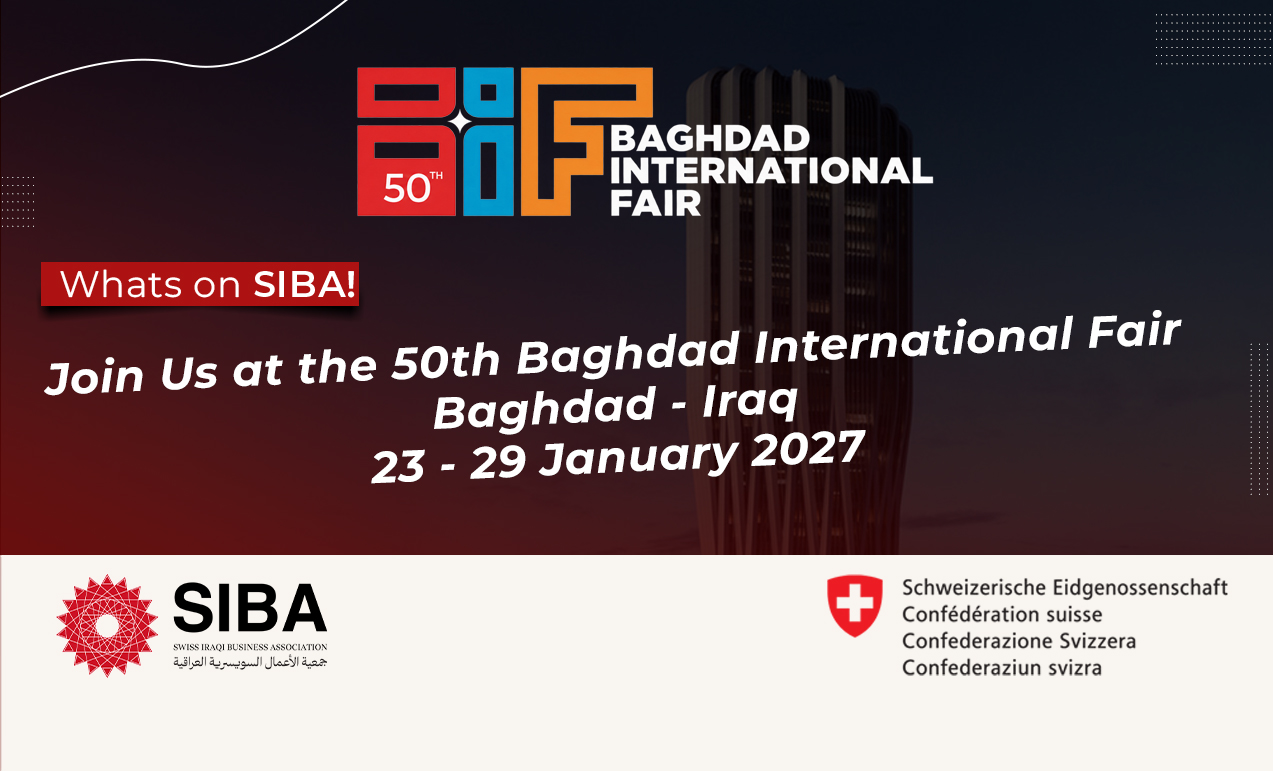
Baghdad to Host the 50th Baghdad International Fair in January 2027
Read the full article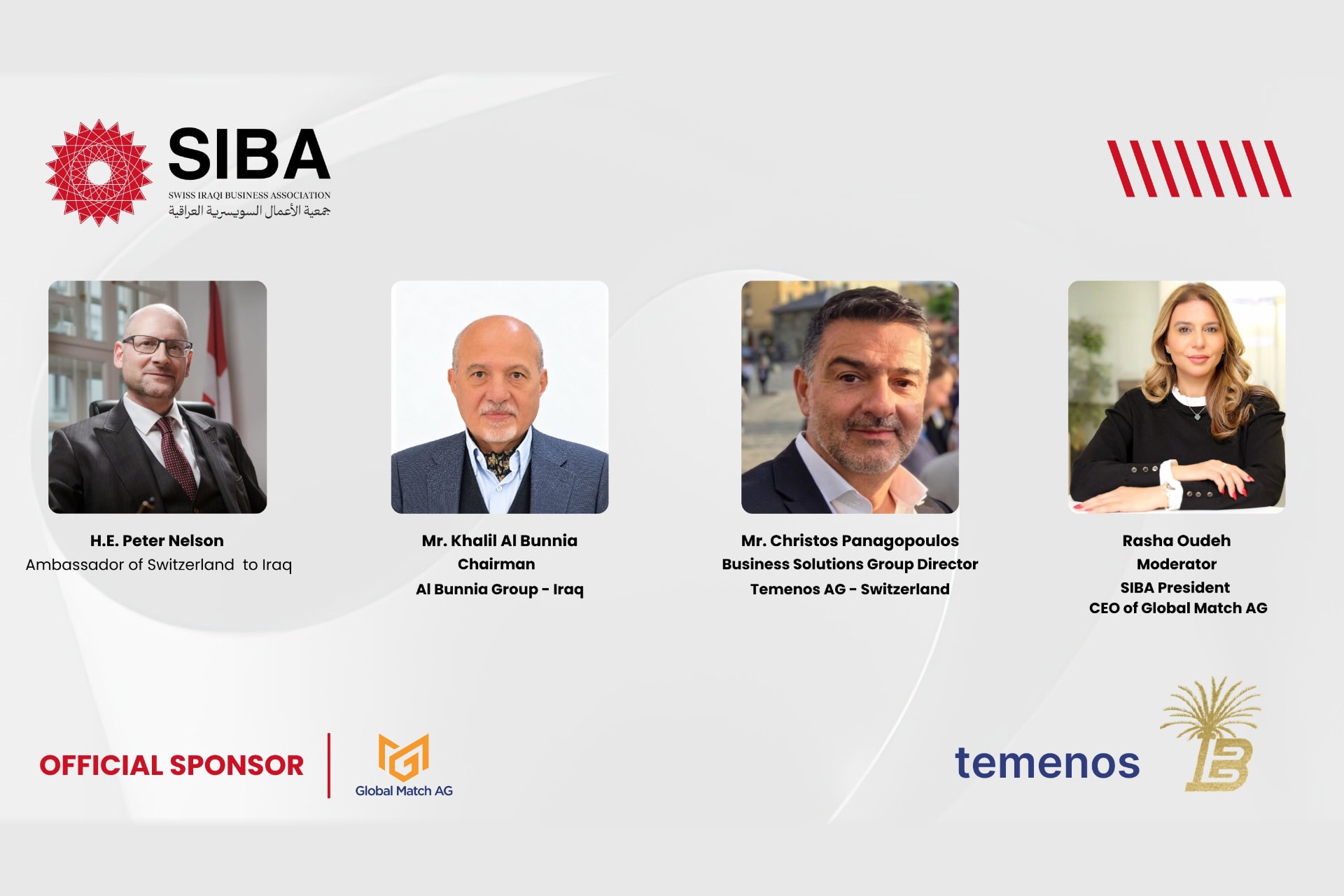
October 15, 2026
Swiss-Iraqi Talk – Episode 3: Save the Date for SIBA's Upcoming Online Event
Read the full article
September 7, 2026